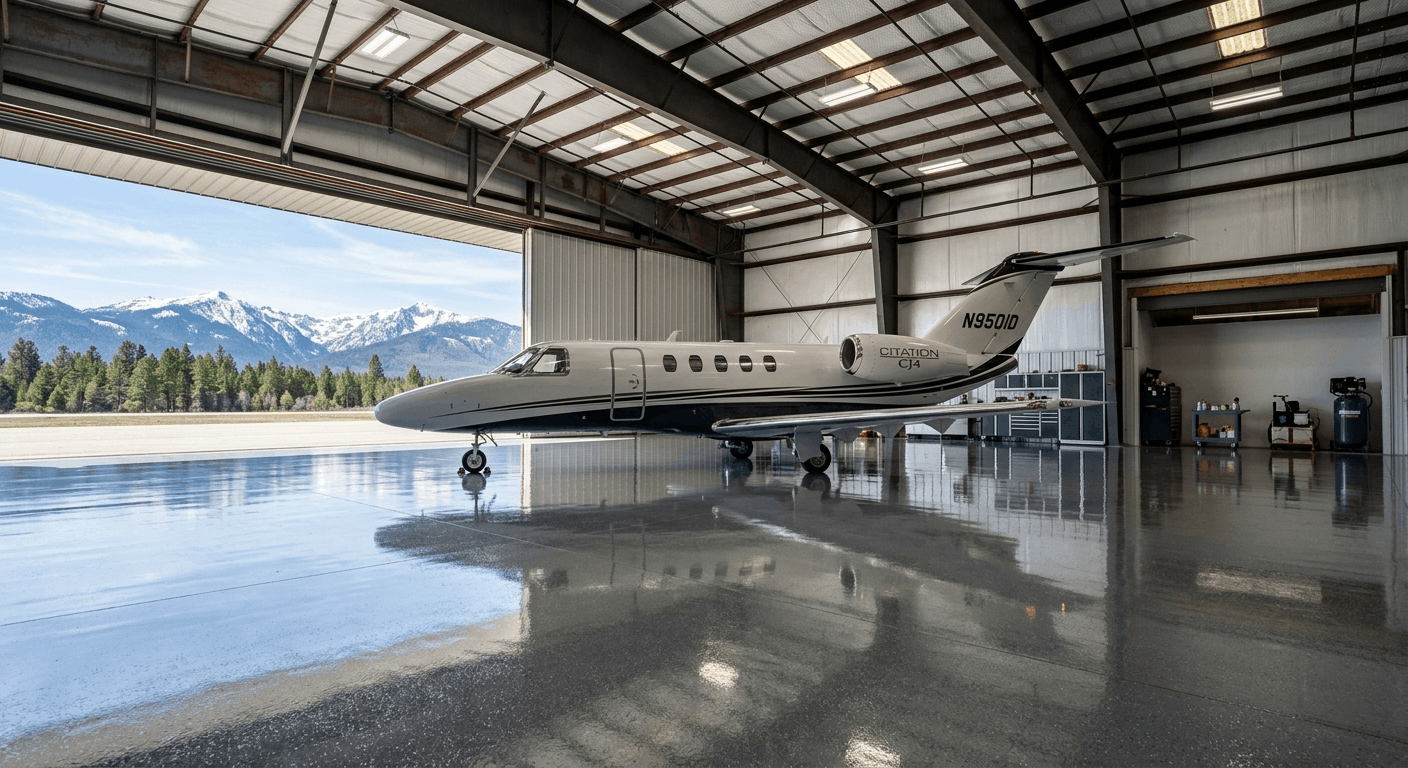
Hangar
Floor
Paint
Hangar floor paint — dust control and light reflectance at the lowest defensible cost
Hangar floor paint means thin-film epoxy and urethane paint, or a densified sealer, for T-hangar rows, tie-down bays and storage hangars where the real complaint is dusting rather than chemical attack. And an honest answer about when that is not enough.
Not every hangar needs forty mil of resin — sometimes hangar floor paint is right
A T-hangar that holds a Cherokee and a tool chest does not have the same floor problem as an MRO bay. Nothing gets spilled on it that matters, nothing heavy pivots on it, and the actual complaint is usually that the bare slab dusts, stains, and makes the whole hangar feel dark.
That is a real problem and it has a cheap, correct solution. Thin-film epoxy or urethane paint at 3 to 8 mil, or a densified sealer with no film at all, will stop the dusting and put light back into the building for roughly half the cost of a full build. Specifying 40 mil of novolac for that hangar would be selling you something you will never use.
What hangar floor paint gives up
Hangar floor paint gives up film thickness, and everything downstream of it. A full system puts 30 to 40 mil between the tire and the concrete; paint puts 3 to 8. That is the whole story on durability, and it is why paint lasts three to seven years in light service where a full build lasts fifteen to twenty.
Hangar floor paint also gives up meaningful chemical resistance. Thin-film paint will shrug off an occasional oil drip, but standing fuel will soften it and phosphate-ester hydraulic fluid will destroy it. If Skydrol is anywhere in your operation, this is not your system and we will say so on the first call.
Where hangar floor paint saves you money — and where it does not
Material is a smaller share of a hangar floor paint job than people expect. Prep is most of the labor, and prep does not get cheaper because the coating is thinner: the slab still has to be ground, the joints still have to be dealt with, and the moisture still has to be tested. That is why paint saves you around 40% rather than the 80% the material pricing implies. Anyone quoting dramatically less than that is skipping the prep, and a coating over unprepared concrete fails no matter what it cost.
Hangar Floor Paint Build
Thin film- Surface prep
- Diamond grind to CSP 1–2 — still mechanical, never acid
- Moisture
- ASTM F2170 tested; thin film is less vapor tolerant, not more
- Total build
- 3–8 mil (vs 30–40 full system)
- Fuel resistance
- Incidental only — not for standing fuel
- Skydrol
- No. Specify novolac epoxy instead
- Service life
- 3–7 years light duty
- Return to service
- Foot 12 hr · tow-in 48 hr
- Recoatable
- Yes — scuff and recoat, no strip needed
- Installed cost
- $3.00–$4.50 / sq ft
- Sealer only
- $1.50–$2.50 / sq ft
Three kinds of aircraft hangar floor paint: sealer, paint, or single-coat epoxy
Hangar floor paint covers three genuinely different products. Which one is right depends on whether you want the slab hardened, colored, or actually coated.
Densified Sealer
Lithium or sodium silicate that reacts with free lime in the concrete to harden the surface from within. No film, no color, no peeling — because there is nothing on top to peel. Stops the chalky dusting that gets into toolboxes and onto airframes.
- Cheapest hangar floor paint option by a wide margin
- Cannot delaminate — it is in the slab, not on it
- No color change, no light gain
- Zero chemical resistance
Thin-Film Paint
Water-borne or solvent-borne epoxy or urethane at 3 to 5 mil. Gives you color, a big jump in light reflectance, and a sweepable surface. This is what most people mean by hangar floor paint, and for a storage hangar it is usually the right call.
- Real light gain — pale hangar floor paint transforms a dark hangar
- Easy to recoat the hangar floor paint when it wears
- Handles incidental drips, not standing fuel
- 3 to 7 years in light service
Single-Coat 100% Solids
One pass of the same 100% solids epoxy we use in the full build, at 8 to 12 mil instead of 20 to 25. Roughly double the cost of paint and roughly triple the life. The sensible middle when a T-hangar row occasionally sees real work.
- Genuine fuel and oil resistance
- 8 to 12 years in light-to-moderate service
- Upgradeable later without stripping
- Still not a Skydrol answer
When we will tell you hangar floor paint is not enough
We would rather lose the hangar floor paint upsell than put a coating in a hangar it cannot survive, because the call we get eighteen months later is worse for both of us. If any of these describe your building, thin-film paint is the wrong specification and we will recommend against it even when you came here asking for it:
- Phosphate-ester hydraulic fluid anywhere in the operation. Skydrol will destroy a thin film. This is not a durability tradeoff, it is a straight incompatibility.
- Tug or tow tractor traffic. A pivoting drive tire concentrates load and torque in a way 5 mil of paint cannot absorb. It shears.
- Turbine aircraft with regular fluid changes. Standing fuel and oil under the gear will soften paint in exactly the places it puddles.
- A slab reading above 80% internal RH. Thin films are less vapor tolerant than thick ones, not more. Vapor pressure that a 30 mil system would resist will lift a 5 mil film off the concrete.
- Anywhere you are grounding ESD-sensitive avionics. That needs a conductive system over a grounded grid, which paint cannot provide at any thickness.
What is genuinely fine for hangar floor paint: cold storage, tie-down rows, T-hangars, wash bays that see water rather than solvent, and any hangar where the aircraft goes elsewhere for maintenance. That is a lot of hangars, and there is nothing second-rate about specifying correctly for one.
Hangar floor paint questions, answered
Hangar floor paint lasts three to seven years in a tie-down or storage hangar, against fifteen to twenty for a full-build system. The difference is film thickness and nothing else — 3 to 8 mil versus 30 to 40. In a maintenance hangar with tug traffic, expect the short end of that range or less, which is usually the point at which the full build turns out to have been cheaper per year.
Hangar floor paint runs $3.00 to $4.50 per square foot installed on sound concrete; a densified sealer alone runs $1.50 to $2.50. Note that prep does not get cheaper just because the coating is thinner, and prep is most of the labor — so the real saving against a full build is around 40%, not the 80% the material pricing would suggest. A quote far below that range is skipping prep.
For cold storage or a tie-down hangar where the complaint is dusting, often yes. A silicate densifier reacts with free lime in the slab and hardens the surface from within, so there is no film to peel. What it will not do is resist fuel, change the color, or brighten the building — if any of those matter, you want paint over the top of it instead.
Yes, and upgrading from hangar floor paint is a reasonable way to phase a budget. A sound thin-film coating can be diamond ground to profile and built over without stripping. Keep the product data sheet from the original install — knowing what is down there saves us a compatibility test later, and it is the single most useful thing to file away after any coating job.
If the existing hangar floor paint is well bonded, yes — scuff, clean and recoat, which is the cheapest floor refresh available. If it is flaking, chalking or lifting at the edges, no. We pull-test before quoting either way, because painting over a failing bond transfers the old failure to your new coating and you pay twice.
More on prep, cure schedules and coating over existing floors on the full FAQ. If your building is a T-hangar row or a storage bay, the aircraft hangar flooring page explains where aircraft hangar floor paint fits by hangar type, and the finishes page covers color and light reflectance.
Tell us what is in the hangar and we will tell you if hangar floor paint fits
If hangar floor paint is enough, we will say so and quote it. If it is not, we will tell you why before you spend the money rather than after.
The heavier systems
Hangar Epoxy Flooring
30 to 40 mil of real chemical resistance. Fifteen to twenty years instead of three to seven.
System 02Polyaspartic Coating
Full build with a 24-hour return to service, and it goes down in an unheated hangar.
AnswersHangar Coating FAQ
Cost, cure times, Skydrol, ESD, warranties and coating over an existing floor.