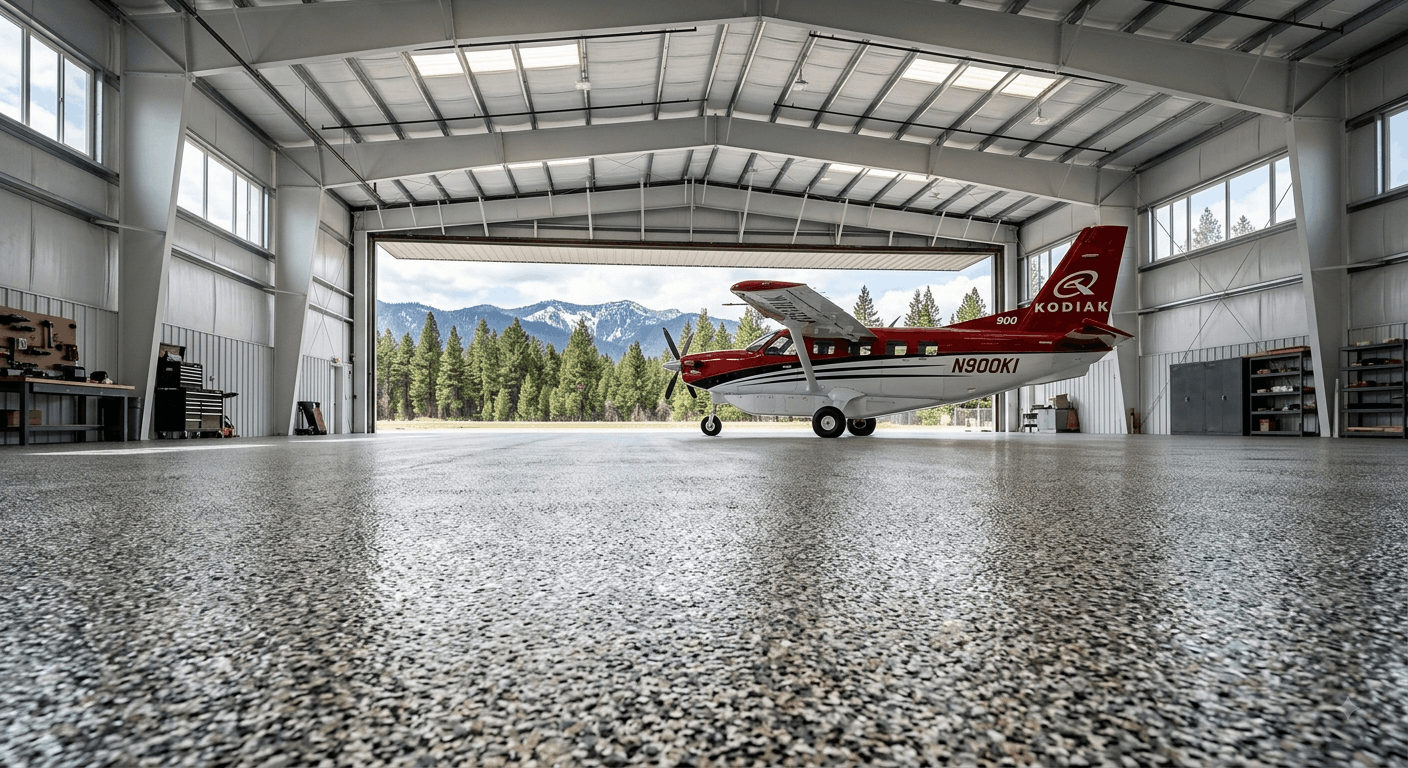
Hangar
Epoxy
Flooring
Hangar epoxy floor systems, high-build 100% solids at 20–25 mil, under a topcoat that does not amber in daylight
The workhorse. A hangar epoxy floor gives more film thickness per dollar than any other chemistry we install, and the best resurfacing value on a rough or previously coated slab — for maintenance hangars, corporate bays, and anywhere the floor takes fluid and abuse daily.
What aircraft hangar epoxy flooring actually is
Hangar epoxy flooring is a multi-coat resin system bonded to a mechanically profiled slab. The body of it is a 100% solids epoxy — no solvent, so what you roll out is what stays — laid at 20 to 25 mil in a single pass. That thickness is the entire point. It is what lets the floor absorb a nose-gear point load and a pivoting tug tire without shearing off the concrete.
What a hangar epoxy floor is not is the epoxy you have seen in a big-box store. Those are water-borne or solvent-borne thin films that cure out at 3 to 5 mil, roughly the thickness of a business card's ink. They belong on a residential garage. Put one in a working hangar and you will be looking at it again inside eighteen months.
Why a hangar epoxy floor never gets left bare
Bisphenol-A epoxy — the chemistry that gives you the build and the chemical resistance — ambers under UV. A hangar with the door open half the day gets plenty of UV, and the bay nearest the opening goes visibly warmer than the back wall within a couple of seasons. It is cosmetic rather than structural, but it looks like a failure and clients read it as one.
So in a hangar epoxy floor the epoxy is the body, never the surface. Over it goes an aliphatic topcoat — polyaspartic or urethane — at 6 to 10 mil, which is UV-stable, harder, and easier to clean. If someone quotes you bare epoxy hangar flooring, the question to ask is what goes over it.
Where flake comes into a hangar epoxy floor
A full flake broadcast is not decoration, or not only. Broadcast vinyl chip into the wet body coat and you get a texture that hides the tire scuffing and dropped-hardware marks a solid color shows immediately, plus a mechanical slip profile without a separate grit pass. The tradeoff is FOD inspection: a busy flake pattern makes a dropped cotter pin harder to spot than a solid gray floor does. Corporate jet bays often go solid for exactly that reason.
Hangar Epoxy Floor Reference Build
Typical hangar- Surface prep
- Diamond grind or shot blast to CSP 2–3
- Moisture
- ASTM F2170 RH probe; mitigation primer above 80% RH
- Primer
- 100% solids penetrating epoxy, 6–8 mil
- Body coat
- High-build 100% solids epoxy, 20–25 mil
- Broadcast
- Vinyl flake or aluminum oxide, to refusal
- Topcoat
- Polyaspartic or aliphatic urethane, UV stable, 6–10 mil
- Total build
- 30–40 mil nominal
- Foot traffic
- 24 hours
- Tow-in
- 72 hours (24 hr with polyaspartic build)
- Full chemical cure
- 7 days
- Installed cost
- $5.50–$8.00 / sq ft
A hangar epoxy floor is specified by the worst fluid, not the most common one
Every hangar epoxy floor has a fluid list to survive. Jet A, 100LL, engine oil, deicing fluid, battery electrolyte, solvent from the parts washer. Standard 100% solids epoxy handles all of that indefinitely, and for most hangars that is the end of the conversation.
Phosphate-ester hydraulic fluid is the exception, and it is the one that ends up in the dumpster stories. Skydrol and Hyjet plasticize a standard epoxy film — not dissolve it, soften it — so the floor goes tacky and starts collecting dirt in exactly the places the fluid puddles: under the gear, along the wing drip line, beside the mule. If you run transport-category aircraft, this is the specification that matters and almost nobody asks about it.
- Novolac epoxy body coat where phosphate ester is routine
- Skydrol-rated urethane topcoat as the alternative approach
- Heavier, grit-broadcast bands detailed under gear positions
- Chemical-resistance data supplied per product, in writing, before you sign
- Cove base and containment curbs where fluid must not reach a drain
When epoxy is the right call — and when it is not
We install three systems and we would rather put you on the correct one than the expensive one. Epoxy is our default recommendation, but it loses on two specific axes and it is worth knowing which.
When a hangar epoxy floor is the best value
You want the thickest, most abrasion-tolerant film per dollar. A hangar epoxy floor gives more build for the money than any other chemistry we install, and on a rough or previously coated slab its self-leveling body coat resurfaces defects that a thin system would telegraph straight through.
- Maintenance hangars and MRO bays suit a hangar epoxy floor
- Corporate hangars where the floor is part of the presentation
- Rough, patched or previously coated slabs, where a hangar epoxy floor resurfaces
- Any hangar where you can give up 3 to 5 days
When a hangar epoxy floor is the wrong call
Epoxy needs 72 hours before an aircraft comes back and it will not cure properly below about 50 °F. Those are hard physical limits, not sales positioning. If either one is a problem, a polyaspartic build solves it and we will say so.
- You cannot displace the aircraft for more than a day — use polyaspartic
- It is February and the hangar is unheated — use polyaspartic
- You need dust control on a budget — use floor paint or a sealer
- You are grounding ESD-sensitive avionics — use static-control flooring
How a hangar epoxy floor goes in
Five days is typical for a single-bay hangar epoxy floor. The order never changes, and the first two steps are where the twenty-year outcome is decided.
Test the slab before any hangar epoxy floor
RH probes drilled per ASTM F2170 and left to equilibrate, a bond pull test, and a joint and crack survey. Above 80% internal RH the slab is pushing vapor and needs a mitigation primer — skip that and the coating will blister and disbond regardless of how well the rest is done.
- ASTM F2170 relative humidity
- ASTM D7234 pull-off adhesion
- Existing coating identification
Profile the slab for a hangar epoxy floor
Diamond grinding or shot blasting to a CSP 2–3 profile, under HEPA vacuum shrouds so we can work near open aircraft. Never acid etching — it leaves residue and an inconsistent profile, and it is the shortcut behind most of the peeling hangar floors we get called out to replace.
- Joints and spalls cut out and rebuilt
- Oil-saturated areas identified and treated
- Dust contained, FOD swept and verified
Prime and lay the hangar epoxy floor body coat
Penetrating primer into the open profile, then the high-build epoxy at gauged thickness. We check wet film with a comb gauge as we go, because that is the only moment the number is verifiable. Flake broadcast to refusal into the wet coat where the finish calls for it.
- Wet film verified per section
- Flake broadcast to refusal
- Cove base and curbs formed
Scrape, vacuum and topcoat the hangar epoxy floor
Excess flake scraped back and vacuumed, then the aliphatic topcoat. Grit is broadcast into the drip zones at this stage rather than across the whole floor, so you get slip resistance where fluid lands without making the entire bay hard to sweep.
- UV-stable aliphatic topcoat
- Grit only where it earns its place
- Gloss level to spec
Lay out the hangar epoxy floor
Tow lines, tail-limit arcs, fire lanes, extinguisher and keep-clear boxes, tool-cart footprints, ESD boundaries. Measured, masked and coated in — not painted back on afterward with a rattle can. If your hangar has never had a proper layout, this is where it gets one.
- Markings coated in, not applied over
- Layout drawing kept on file for recoats
What a hangar epoxy floor costs
Installed, including prep. Slab condition moves a hangar epoxy floor quote more than the product selection does — heavy oil saturation, spalling, or a missing vapor barrier all add prep before any resin goes down.
A 12,000 sq ft corporate bay in flake therefore lands around $78,000 for the finished hangar epoxy floor. We will not quote a number like that without testing the slab first, because the only way to be confident in it is to know what is under the coating.
Hangar epoxy flooring, answered
A hangar epoxy floor should be thirty to forty mil total: a penetrating primer at 6 to 8 mil, a high-build 100% solids epoxy body coat at 20 to 25 mil, and a UV-stable topcoat at 6 to 10 mil. Anything under 20 mil total is a thin-film coating and will not survive nose-gear point loading and tug traffic. A quote that says "high-build epoxy" without a mil number is a quote to spread the material as thin as it will go, and it is the single most common way these jobs get underbid.
A hangar epoxy floor handles Jet A and 100LL indefinitely, with almost any correctly cured 100% solids epoxy. Skydrol is the different problem. Phosphate-ester hydraulic fluid plasticizes a bisphenol-A film and turns it soft where it puddles — under the gear and along the wing drip line. For transport-category hangars we specify a novolac epoxy body coat or a Skydrol-rated urethane topcoat, and we detail the drip zones with a heavier build.
A hangar epoxy floor allows foot traffic at 24 hours, tow-in at 72 hours, full chemical resistance at 7 days. Those are real numbers and we put them in the contract. If 72 hours does not work for your operation, that is precisely what the polyaspartic system exists to solve — same prep, same build philosophy, tow-in at 24 hours instead.
Usually. A sound, well-bonded hangar epoxy floor can be diamond ground to profile and recoated, and that is the cheapest route to a new floor. Failing, delaminating or oil-saturated coatings have to come off first — recoating over a bad bond just buys you the same failure a year later, and it will be your money the second time. We core and pull-test any previously coated slab before quoting.
A hangar epoxy floor is rigid, so it tracks the slab: if the concrete cracks under it, the coating will telegraph that crack. This is why the joint survey happens before pricing. Control joints get honored rather than coated over, moving joints get a flexible sealant detail, and where a slab is known to be active we will recommend a polyaspartic build instead, because it stays elastic enough to bridge minor movement.
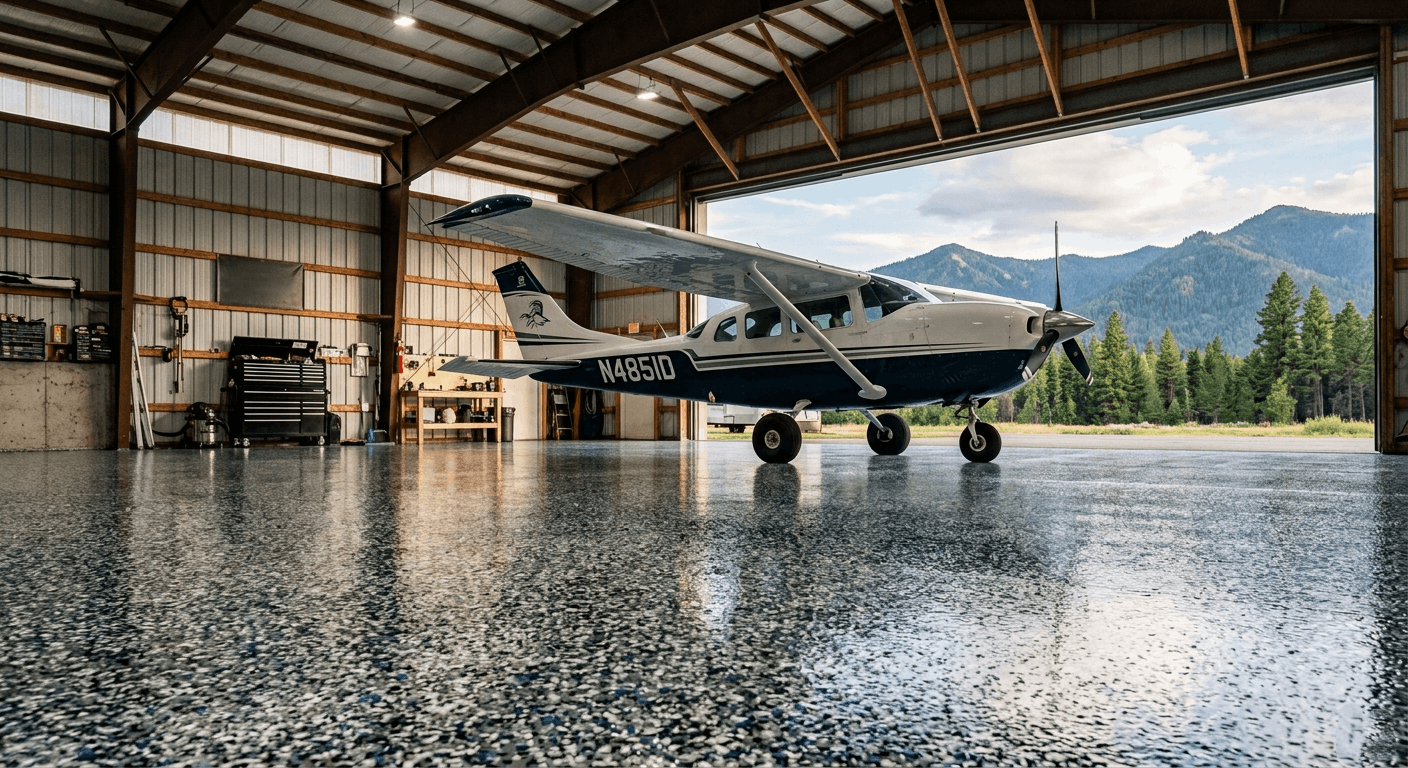
On a hangar epoxy floor, flake hides tire scuff and dropped-hardware marks and adds slip texture, which suits maintenance and MRO bays. Solid color makes FOD dramatically easier to spot, which is why corporate jet bays often go solid gray despite it showing more wear. A pale, high-gloss floor of either kind throws your existing fixtures back up into the airframe, and that is the difference between catching a hydraulic weep on a walkaround and missing it.
More on cure schedules, warranties, cold-weather work and markings on the full FAQ. The full install sequence is on the process page, color and flake options are on the finishes page, and if you are still pouring the slab, start with the hangar floor design guide.
Get a written hangar epoxy floor spec
Square footage, the aircraft you handle, and how many days you can give up. You will get a system recommendation with mil thickness, cure schedule and a real number, at no cost.
The other two systems
Polyaspartic Coating
Cures in hours, applies down to 0 °F, tow-in at 24 hours. The answer when the hangar cannot sit idle.
System 03Hangar Floor Paint
Thin-film epoxy, urethane paint, or a densified sealer for T-hangars and storage bays.
IndustryAircraft Hangar Flooring
Load, chemistry and marking requirements across storage, corporate and maintenance hangars.