Aircraft
Hangar
Flooring
Aircraft hangar flooring specified by what the hangar actually does, not by what is cheapest to roll out
A T-hangar row and a wide-body MRO bay are both hangar floors and almost nothing about the correct spec is shared between them. This page is the aircraft hangar flooring decision, hangar type by hangar type — what lands on the floor, what rolls across it, how many days you can lose, and which system earns its price.
Aircraft hangar flooring is a mission spec before it is a product
Ask five bidders what aircraft hangar flooring should be and you will get five product names. That is backwards. The hangar floor is the last surface in the building to get designed and the first one to get abused, and the only way to choose correctly is to describe the duty first: the heaviest wheel load that will ever pivot on it, the worst fluid that will ever puddle on it, and the longest outage the operation can absorb.
Those three answers narrow aircraft hangar flooring faster than any brochure. A tie-down T-hangar with a single-engine piston aircraft and a tenant who is never displaced can take a thin-film system. A heavy maintenance bay full of phosphate-ester hydraulic fluid and jacked airframes cannot take anything under a high-build resin with an upgraded resistance package. Everything else sits between those two, and the hangar floor you end up with should be a defensible point on that line rather than whatever the last crew had on the truck.
What every aircraft hangar flooring job has in common
Regardless of type, four things do not change. The slab has to be mechanically profiled — diamond ground or shot blasted to an ICRI CSP 2–3, never acid etched. Internal relative humidity has to be measured per ASTM F2170 before anyone prices the work, because vapor drive is the most common reason hangar floors let go. Film thickness has to be a stated number in the contract rather than an adjective. And the finish coat has to be UV-stable, because a hangar door is a hundred-foot-wide window and bare epoxy ambers in it.
Get those four right and aircraft hangar flooring comes down to a resin and build question. Get any of them wrong and it does not matter which system you bought.
Hangar Type → System
Decision table- T-hangar row
- Paint or sealer · $3–$4.50
- Private box hangar
- Thin-film or flake epoxy · $3–$6.50
- Corporate / FBO bay
- Full-build epoxy + gloss topcoat · $5.50–$8
- Line service / fuel
- Epoxy with grit-broadcast drip zones
- MRO / heavy maintenance
- Novolac or fuel-resistive build · $8–$12
- Avionics / composites
- Static-control system · $8–$12
- Military hangar
- Per the project spec section — often MPI 212
- Cannot lose a week
- Polyaspartic · tow-in at 24 hr
- Winter, unheated
- Polyaspartic, cures to 0 °F
Six hangar types, six different aircraft hangar flooring answers
Each of these is a real aircraft hangar flooring decision with its own failure mode. The system named is where we would start; the assessment is what confirms it.
T-hangar rows
Duty: one to two light aircraft per stall, tenant-owned, low fluid volume, heavy dust. Failure mode: nobody budgets for it, so it never gets done and the concrete dusts into the airframes. Spec: a densified sealer or thin-film paint is usually the honest answer — dust control and light reflectance at the lowest defensible cost, applied stall by stall so the row keeps earning. The mistake is quoting forty mil of aircraft hangar flooring into a building whose rent will never pay it back.
Private and box hangars
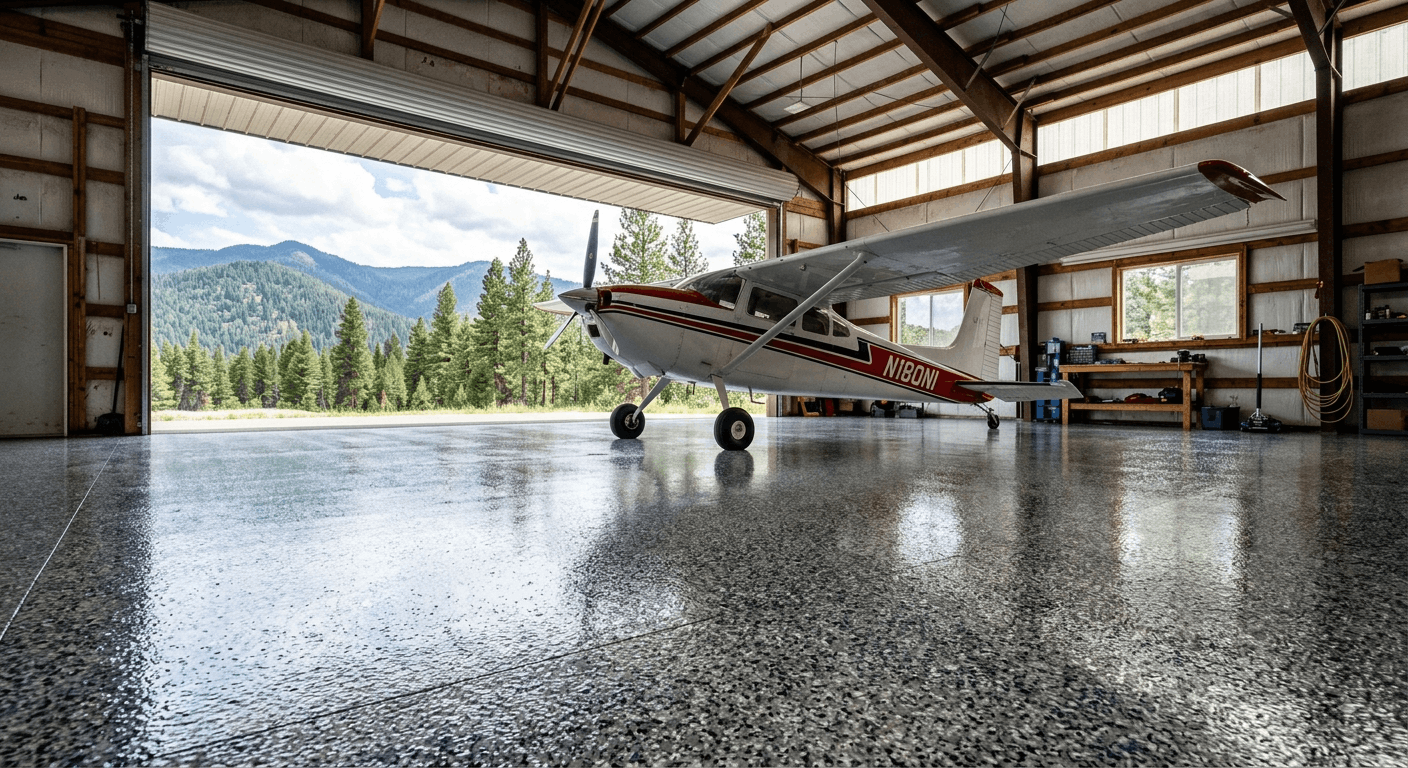
Duty: one owner, one or two aircraft, a workbench, a tug, and a floor the owner actually looks at. Failure mode: a garage-grade kit rolled at 4 mil that scuffs off under the nose tire in a season. Spec: aircraft hangar flooring built as a full flake broadcast over high-build epoxy hits the appearance target and the durability target at once, and it hides the tire marks a solid color shows on day one. This is the most common airplane hangar flooring job we quote.
Corporate and FBO hangars
Duty: the aircraft hangar flooring is part of the customer experience, and it also takes tug traffic, GPU carts, baggage tugs and fuel-truck adjacency. Failure mode: a beautiful gloss floor with no slip detailing, installed in a building where line crews walk in with wet or deiced boots. Spec: high-build epoxy, light solid color or fine flake for reflectance, high-gloss aliphatic topcoat, and a grit-broadcast band at the door line and under the fuel drip zones. Solid gray makes FOD easier to spot before it goes through an engine.
MRO and heavy maintenance
Duty: jacks and cribbing, engine stands, solvent, parts washers, and phosphate-ester hydraulic fluid in every drip zone. Failure mode: a standard bisphenol-A epoxy that goes soft and tacky where Skydrol puddles under the gear. Spec: a novolac epoxy body coat or a fuel-resistive multi-coat build, a heavier grit-broadcast band under gear and wing positions, cove base where fluid must not reach a wall, and a marked layout that survives recoat. This is the aircraft hangar flooring tier where the epoxy system detail matters most.
Avionics, composite and paint bays
Duty: open electronics, carbon dust, solvent wipe, and in paint bays, overspray. Failure mode: ordinary aircraft hangar flooring in a room that needed a grounded floor, or a permanent gloss floor in a bay that is repainted twice a month. Spec: a conductive or static-dissipative system over a grounded grid in the electronics and composite areas — that is covered on the aerospace flooring page — and in paint bays, a durable base system that a sacrificial strippable coating can be laid over between jobs.
Military hangars
Duty: whatever the project specification says, plus base access, escort, and hot-work rules. Failure mode: a contractor who bids commercial aircraft hangar flooring into a federal spec section and discovers the difference at submittal. Spec: read the section. DoD hangar work is usually written against UFC 4-211-01 for the facility and a named guide specification for the floor — see the section below for the documents that actually apply.
Aircraft hangar floor covering: when tiles and mats are the right answer
Not every hangar floor should be a coating, and pretending otherwise is how contractors lose credibility. Interlocking PVC and polypropylene tiles, roll-out vinyl, and rubber mats are real products with real jobs, and there are three situations where they beat any aircraft hangar flooring we install.
- You do not own the building. A leased T-hangar or a short tenancy is the textbook case for a floor covering — it goes down in a weekend, it comes up with you, and no landlord approval is needed.
- You need it today. There is no cure schedule. Tiles are walkable and drivable the same hour they are laid.
- The slab is not worth coating yet. Badly spalled or heavily oil-saturated concrete that will be replaced in two years can be covered rather than resurfaced.
Where it goes wrong is fluid and point load. Every tile system has seams, and fuel, oil and hydraulic fluid find them — the liquid ends up between the covering and the concrete where you cannot see it, cannot clean it, and cannot stop it soaking into the slab. Add a tug, a jack, or a nose wheel pivoting in place and the tiles creep, gap and lift at the edges. In a maintenance environment seamless resin aircraft hangar flooring is not a preference, it is the only thing that keeps the fluid on top where a mop can reach it.
Ask Which One Your Hangar NeedsWhich documents actually govern military aircraft hangar flooring
There is a lot of specification name-dropping in this industry, most of it wrong. Here is what applies to aircraft hangar flooring inside a DoD maintenance hangar, and what does not.
The documents that govern aircraft hangar flooring
- UFC 4-211-01, Aircraft Maintenance Hangars — the facility criteria. It is where the hangar bay floor finish requirement lives, and it points at a thin-film epoxy flooring system.
- MPI 212 — the Master Painters Institute product standard for thin-film floor coating in aircraft maintenance facilities. If a submittal has to name a product category, this is usually it.
- UFGS 09 62 50.10 — Thin Film Flooring System for Aircraft Maintenance Facilities, the guide specification section itself.
- UFGS 09 67 23.15 / .16 — Fuel Resistive Resinous Flooring, three-coat and five-coat, where the bay needs more than thin film.
- NFPA 409 — Standard on Aircraft Hangars, which drives floor drainage and the fire protection the floor has to live with.
Two specs that get cited and should not be
MIL-PRF-24667 is the Navy non-skid coating system specification, and its scope is weather decks, flight decks and hangar decks of ships — steel and aluminum decks aboard carriers, amphibious and auxiliary vessels. It is a shipboard product standard. It has nothing to say about a concrete slab in a shore-based hangar, and quoting it at a facility engineer is a tell.
UFC 3-260-02 is Pavement Design for Airfields. It governs runway, taxiway and apron pavement structure — the engineering of the concrete and its subgrade — not the coating applied to an interior hangar floor. It is a useful document if you are designing the slab; it is the wrong citation for a floor finish.
If a bidder cites either one at you as a credential, ask them which paragraph they are relying on.
We install to the specification section in your project documents. Where the section is silent or dated, we will say so in writing rather than substituting quietly. Getting the slab right in the first place is the hangar floor design guide.
What actually loads aircraft hangar flooring
The aircraft is rarely the problem. The slab carries the weight; the coating carries the contact pressure. These are the loads that decide aircraft hangar flooring film thickness.
Tire contact pressure
A nose tire puts a large fraction of its load through a patch the size of a hand, and it does it while pivoting during a push-back. That shear, not the gross weight, is what tears thin films off concrete.
Jacks and cribbing
A jack pad concentrates several tons into a few square inches for days at a time. In maintenance bays we build heavier where jacking points repeat, and we expect indentation testing to be asked about.
Tugs, stands and carts
Steel-wheeled engine stands and loaded tool carts do more visible damage to a hangar floor over a year than the aircraft does. Hard aliphatic topcoats and adequate build are the defense.
Aircraft hangar flooring, answered
There is no single best aircraft hangar flooring — there is a best answer for your duty cycle. For a maintenance or corporate hangar, a high-build epoxy at 20 to 25 mil under a UV-stable aliphatic topcoat is the default, because it gives the most film per dollar and survives pivoting tire loads. For a T-hangar row where the goal is dust control, a densified sealer or thin-film paint is the honest choice. For a hangar that cannot be emptied for a week, polyaspartic. For avionics and composite work, a grounded static-control system. The wrong answer is picking the product before describing the duty.
Installed, aircraft hangar flooring runs $3 to $12 per square foot. A densified sealer or thin-film paint program on sound concrete is $3 to $4.50. A full-build epoxy hangar floor with a polyaspartic topcoat is $5.50 to $8. Static-control and fuel-resistive builds for MRO bays are $8 to $12. Slab condition moves those numbers more than product selection does: oil saturation, spalling, failed prior coatings and a missing vapor retarder all add prep before any resin is opened.
For a leased hangar, a short tenancy, or a slab too far gone to coat, yes — an interlocking tile or mat floor covering goes down in a day, costs nothing in downtime, and leaves with you. For a hangar where fuel, oil or hydraulic fluid hits the floor, no. Every tile system has seams, fluid migrates under them, and what collects between the covering and the concrete cannot be seen or cleaned. Tug and jack loads then creep and gap the tiles. Seamless resin is the only way to keep the fluid on top of the floor.
It needs whatever the project specification section names, which for DoD aircraft maintenance hangars is usually a thin-film epoxy flooring system in line with UFC 4-211-01 and MPI 212, or a fuel-resistive resinous system where the bay demands it. The chemistry is not exotic; the compliance paperwork, submittals, base access and hot-work permitting are the real difference. Be sceptical of anyone citing MIL-PRF-24667, which is a shipboard non-skid deck specification, or UFC 3-260-02, which is airfield pavement design.
Yes, and on a working field it is usually how the job gets done. We phase by bay or by stall, contain dust with HEPA-shrouded grinders so we can work near open aircraft, and keep the remainder of the hangar operational behind poly containment. The constraint is cure, not application: the coated area has to reach tow-in strength before aircraft come back over it, which is 24 hours with polyaspartic and 72 with conventional epoxy. The install process walks through the phasing in detail.
A correctly specified and correctly prepped high-build system in a maintenance hangar should give fifteen to twenty years of service with a topcoat refresh somewhere in the middle. A thin-film paint or sealer in a T-hangar is a three to seven year finish and should be budgeted as one. The variable is almost never the resin — it is whether the slab was profiled properly, whether moisture was measured, and whether the stated mil build was actually achieved.
Cost, cure schedules, markings, cleaning and warranty questions are on the full hangar floor coatings FAQ.
Tell us what the hangar does. We will tell you what the floor should be.
Square footage, the aircraft you handle, the fluids that hit the deck, and how many days you can give up. You get a written aircraft hangar flooring recommendation with mil thickness, cure schedule and a real number, at no cost.
Next on the hangar floor
Hangar Epoxy Flooring
The high-build workhorse: 30–40 mil, what it resists, what it costs, and when it is the wrong call.
GuideHangar Floor Design
Building new? What to put in the slab spec so aircraft hangar flooring can go down properly later.
IndustryAviation Flooring
Beyond the hangar: FBO lobbies, line service, flight schools, GSE shops and fuel containment.