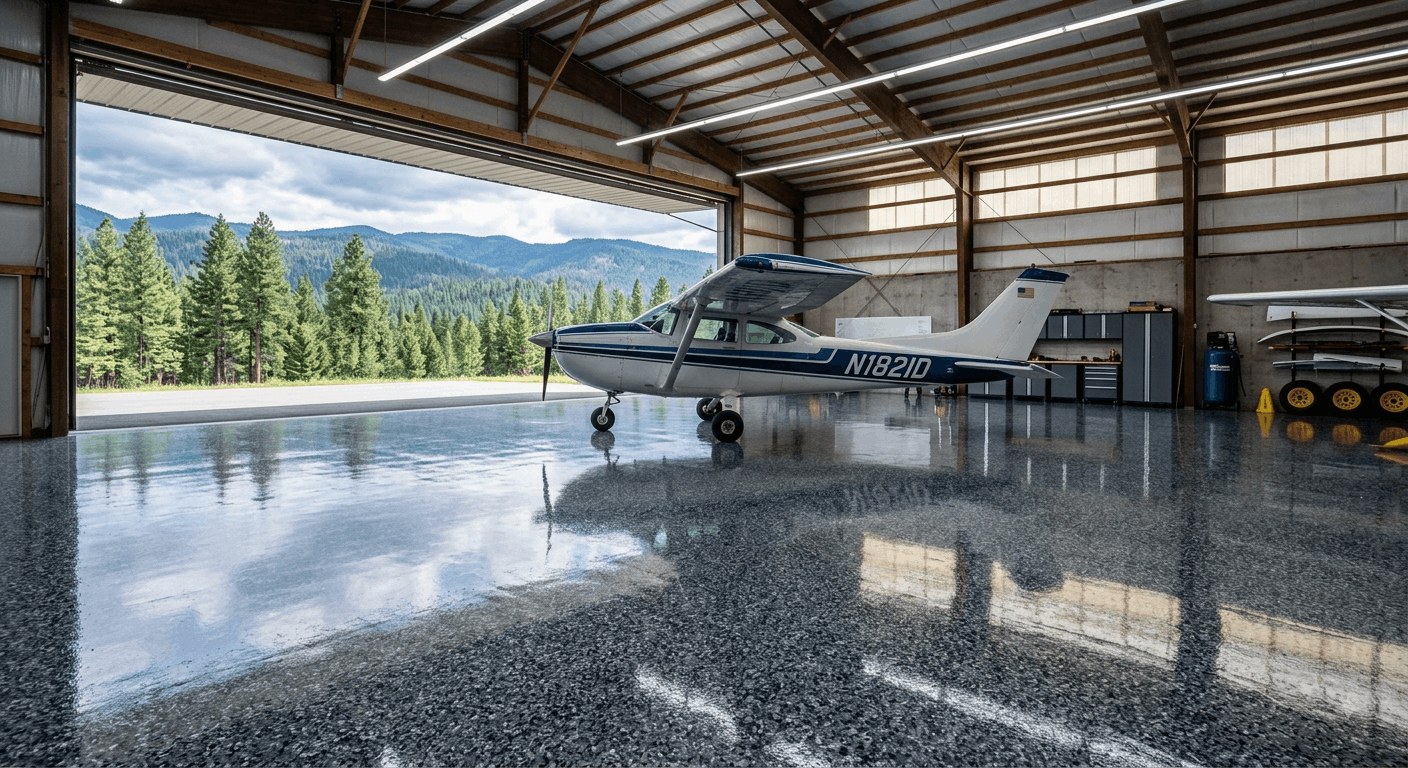
Hangar
Polyaspartic
Coating
Foot traffic in hours, aircraft towed back in at 24 — tow in tomorrow
Hangar polyaspartic coating cures in hours instead of days and stays flexible enough to bridge minor slab movement. Applies down to 0 °F, so an unheated hangar in February is still a workable window. The answer when the aircraft cannot be displaced for a week.
Downtime is a line item, so we treat it like one
An empty FBO hangar is lost tie-down income. An empty MRO bay is a slipped delivery. For a lot of operators the coating decision is not really a chemistry decision at all — it is a question of how many days the floor can be out of service, and everything else follows from that.
Hangar polyaspartic coating is the answer to that question. It is an aliphatic polyurea chemistry that reaches foot-traffic hardness in four to six hours and full tow-in strength in twenty-four, against seventy-two hours or more for a conventional epoxy. On a single-bay hangar that is usually the difference between losing one day and losing most of a week.
Why hangar polyaspartic coating cures the way it does
Hangar polyaspartic coating is a two-component system whose reaction rate is set by the ester used, not by ambient warmth. That has two consequences worth understanding before you specify it. The good one: it keeps curing down to about 0 °F, where epoxy effectively stops below 50, so an unheated hangar in February is a workable window rather than a spring wait.
The one that constrains us: pot life is short, sometimes under twenty minutes, and it gets shorter as conditions get colder. That is a crew-size and choreography problem rather than a quality problem, but it does mean polyaspartic is unforgiving of an installer who has not done many. There is no going back to fix a lap mark after the fact.
Hangar polyaspartic coating is usually a hybrid, not a replacement
We rarely install a hangar polyaspartic coating alone. The most common build is an epoxy body coat for film thickness with a polyaspartic topcoat over it — epoxy is still the cheapest way to get 20 mil of material onto a floor, and polyaspartic is the better surface. When the schedule is genuinely tight we go polyaspartic top to bottom and accept the higher material cost to compress the install into one or two days.
Hangar Polyaspartic Coating Cure Schedule
vs. epoxy- Tack free
- 1–2 hr · epoxy 8–12 hr
- Foot traffic
- 4–6 hr · epoxy 24 hr
- Recoat window
- 2–4 hr · epoxy 12–24 hr
- Aircraft tow-in
- 24 hr · epoxy 72 hr
- Full chemical cure
- 3 days · epoxy 7 days
- Min. application temp
- 0 °F · epoxy 50 °F
- Pot life
- 15–30 min · epoxy 30–45 min
- UV stability
- Will not amber · epoxy ambers
- Typical total build
- 25–35 mil
- Installed cost
- $6.00–$9.00 / sq ft
We schedule a hangar polyaspartic coating the way you plan a maintenance event
A hangar polyaspartic coating only helps if the install is organized around your operation rather than ours. That means bay-by-bay phasing so part of the hangar stays live, crews that work nights and weekends around flight schedules, and return-to-service milestones written into the scope instead of promised on the phone.
It also means dust discipline. Grinding happens under HEPA vacuum shrouds, and where aircraft stay in the building we hoard off the work area and monitor it. FOD control is not an afterthought on a hangar deck — we sweep, magnet-sweep and verify before anything gets towed back over the floor we just finished.
- Bay-by-bay hangar polyaspartic coating phasing so the hangar never fully closes
- Night and weekend crews to work around flight schedules
- Return-to-service milestones written into the contract
- Cold-weather hangar polyaspartic coating application down to 0 °F
- HEPA-shrouded grinding and verified FOD sweeps near open aircraft
- Badging, escort and hot-work permits handled as routine
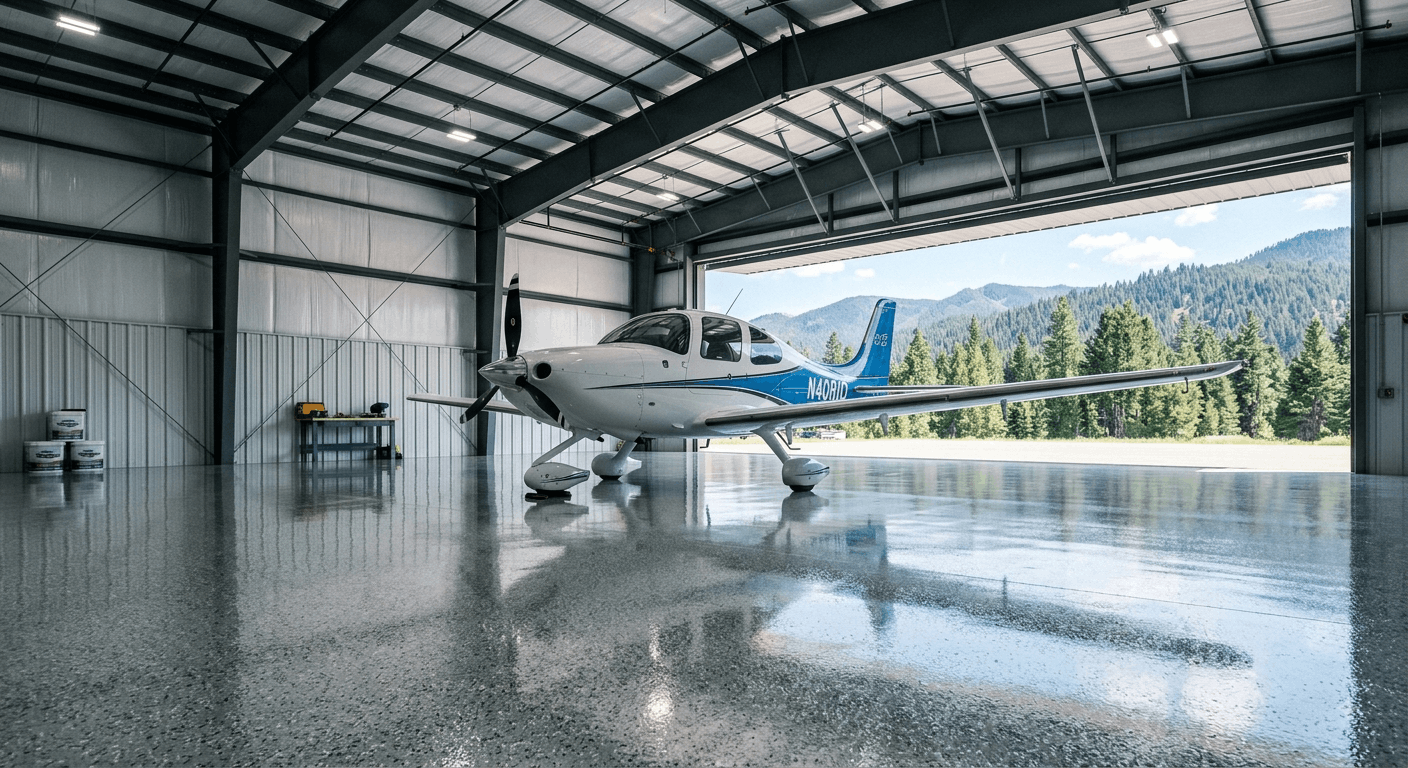
When hangar polyaspartic coating speed is worth paying for
Hangar polyaspartic coating is not automatically the better system. It is the better system when time or temperature is the binding constraint — and it is worth being clear about when it is not.
When you cannot lose the week
- Revenue hangars where every idle day has a number attached
- MRO bays with a delivery date that will not move
- Single-aircraft hangars with nowhere else to put the aircraft
- Winter hangar polyaspartic coating work in an unheated building
- Slabs with minor active movement that would crack rigid epoxy
- Any floor where ambering would be visible and unacceptable
When build per dollar is the goal
- You can give up three to five days without it costing anything
- The slab is rough and needs a thick self-leveling body coat
- Budget is the binding constraint, not schedule
- You want maximum film thickness per dollar spent
In most of these cases the right answer is still a hangar polyaspartic coating topcoat over an epoxy body coat — you get the build from the epoxy and the color stability from the polyaspartic.
What a hangar polyaspartic coating install actually looks like
A single 10,000 sq ft bay, full hangar polyaspartic coating build, aircraft displaced the evening before and back the following evening.
Grind and prep for the hangar polyaspartic coating
Diamond grinding to CSP 2–3 under HEPA shrouds, joints and spalls cut and rebuilt, floor vacuumed and FOD-swept. Slab moisture was tested and cleared in the assessment weeks earlier — this is not the morning to discover a vapor problem.
Prime and base
Hangar polyaspartic coating primer into the open profile, then the pigmented base coat with flake broadcast to refusal where the finish calls for it. Short pot life means the crew works in tight, choreographed sections with a dedicated mixer.
Scrape, vacuum, topcoat
Excess flake scraped and vacuumed, grit broadcast into the drip zones, then the clear aliphatic topcoat across the bay. This is the last wet coat of the day.
Layout and markings
Tow lines, tail-limit arcs, fire lanes and keep-clear boxes masked and coated in over the cured topcoat. Walkable behind the crew as they go.
Tow the aircraft back in
Full tow-in strength. Chemical resistance continues developing for another two days, so we ask you to keep fuel and solvent off it until day three — that is the one restriction that outlasts the install.
Hangar polyaspartic coating, answered
A hangar polyaspartic coating reaches foot traffic at four to six hours after the topcoat, aircraft tow-in at twenty-four. We write both into the contract. The one caveat we ask you to honor is fuel and solvent exposure — full chemical resistance takes about three days, so a fuel spill on day one is worse than a fuel spill on day four.
Down to about 0 °F, yes — hangar polyaspartic coating keeps curing in the cold. This is the single biggest practical advantage over epoxy, which effectively stops curing below 50 °F. Cold actually shortens our working time rather than lengthening it, so a winter install needs a larger crew — but it is a real option in January rather than something you wait until May for.
A hangar polyaspartic coating is harder at the surface, UV-stable so it will not amber, and flexible enough to bridge minor slab movement that would crack rigid epoxy. Epoxy still wins on film build per dollar. That is exactly why the two get combined so often — epoxy body coat for thickness, polyaspartic topcoat for speed, hardness and color stability.
Per gallon, a hangar polyaspartic coating costs considerably more. Installed, usually not by much — $6 to $9 per square foot against $5.50 to $8 for epoxy — because the labor compresses into fewer days. Once you price in displaced aircraft or lost tie-down revenue, polyaspartic is frequently the cheaper option overall. We will run that comparison for your hangar rather than asking you to take it on faith.
A high-gloss hangar polyaspartic coating with nothing broadcast into it is slick when wet, and a hangar door lets in weather. We broadcast aluminum oxide or polymer grit into the topcoat in the drip zones and along walking paths rather than across the whole bay, which gets you the traction where fluid actually lands without making the entire floor difficult to sweep.
More on cure schedules, warranties and cold-weather work on the full FAQ. Cold-season installs are routine in our home region — see Spokane and the Inland Northwest — and the finishes page shows what the gloss topcoat looks like.
Tell us how many days you can give up for a hangar polyaspartic coating
We will tell you honestly whether a hangar polyaspartic coating is worth the premium for your hangar, or whether an epoxy build with a polyaspartic topcoat gets you the same outcome for less.
The other two systems
Hangar Epoxy Flooring
The high-build workhorse. Most film thickness per dollar, best value on a rough slab.
System 03Hangar Floor Paint
Thin-film epoxy, urethane paint, or a densified sealer for T-hangars and storage bays.
MethodOur Process
Slab testing, mechanical prep and the mil verification that decides whether any of it lasts.